
Local GuidesMold Prevention
Why is there black mold growing on my Bradenton bathroom ceiling
Black mold on a Bradenton bathroom ceiling is almost always a humidity and ventilation problem, not a cleaning problem. Here is what causes it and how to fix it.
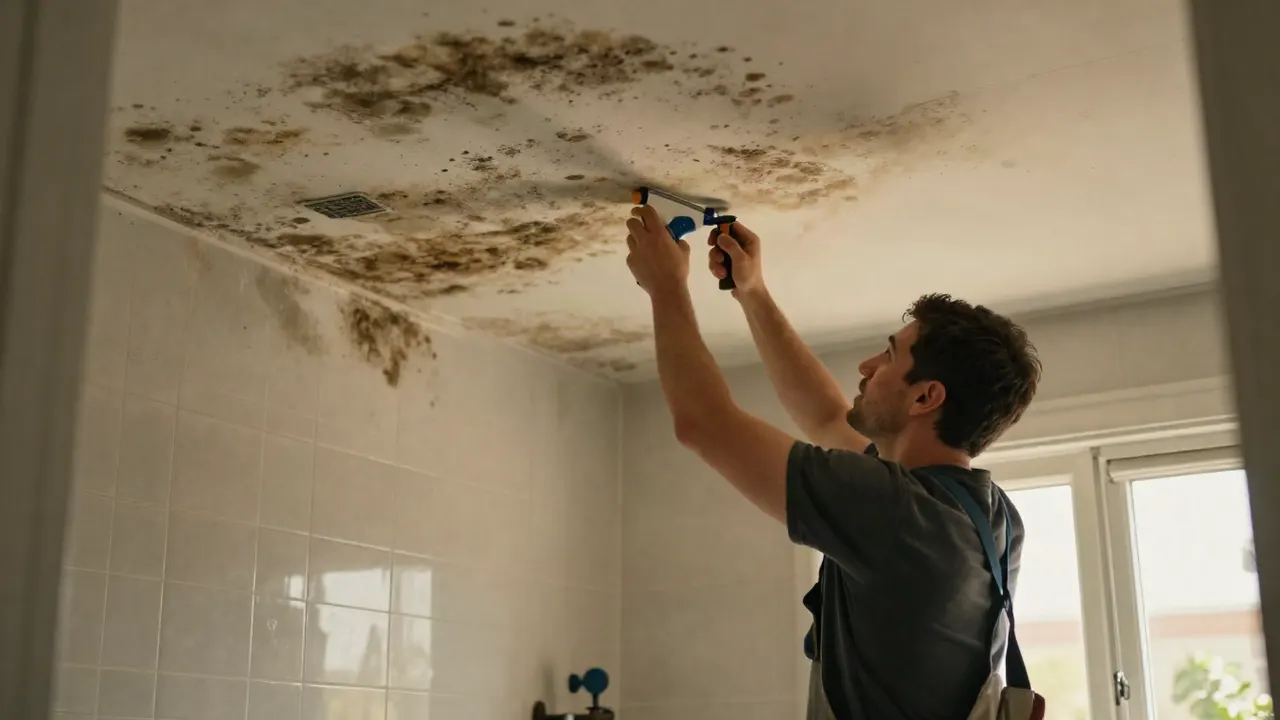
Black mold on a Bradenton bathroom ceiling grows because warm, humid air rises, hits a cooler ceiling surface, and condenses into a thin film of water that mold spores feed on. In this climate, that cycle can start within 24 to 48 hours of a single long shower, and once the ceiling stays damp, the mold keeps coming back no matter how many times you wipe it down. Below we break down exactly why it happens here, how to tell a surface stain from a real problem, and when it is time to bring in a professional.
We are a local mold remediation company, and bathroom ceilings are one of the calls we run most often in Bradenton. If you want the short version: the mold is a symptom, the moisture is the cause, and the fix is almost always ventilation plus a moisture source you have not found yet. Here is the full picture.
Why black mold grows on Bradenton bathroom ceilings
Black mold on a bathroom ceiling in Bradenton is a moisture problem that shows up as a stain, not a stain that happens to be wet. Mold needs three things to colonize: organic food (drywall paper, paint, joint compound), a surface temperature at or below the dew point, and sustained moisture. Bradenton supplies the third one for free.
Our average relative humidity runs 70 to 80 percent most of the year, and summer dew points sit in the mid-70s. When you take a 10-minute hot shower, the air in a small bathroom can hit 95 to 100 percent humidity within two minutes. That air rises, hits a ceiling that is often 5 to 10 degrees cooler than the room, and condenses. The ceiling stays wet for hours after you towel off. Do that twice a day for a week and you have a mold farm.
The reason it looks black is usually not one species. What homeowners call "black mold" on a Bradenton bathroom ceiling is most often a mix of Cladosporium, Penicillium, and Stachybotrys - the last one is the true black mold, and it needs chronic wetness, not a one-time splash, to take hold. If you are seeing it, the ceiling has been damp for a while.
If you have already tried bleach and it came back in two weeks, that is the tell. You killed the surface growth and left the moisture source untouched. For a full breakdown of how we handle that, see our Black Mold Removal Bradenton FL process.
What causes bathroom ceiling mold in Bradenton, Florida
Bathroom ceiling mold causes in Bradenton come down to five things, and most homes have at least two of them working at once.
- No exhaust fan, or a fan that moves almost no air. A working bathroom fan should pull 50 to 110 CFM. Most builder-grade fans in homes built before 2005 move 50 CFM on a good day, and many are down to 20 to 30 CFM once the bearings wear and the grille clogs with dust. That is not enough to clear a Bradenton shower.
- A fan ducted into the attic instead of outside. This is the single most common defect we find in Bradenton. The fan runs, the moisture goes into the attic, and the bathroom ceiling stays wet because the air never actually leaves the building. You get mold on the ceiling and mold in the attic.
- Short run times. Running the fan for five minutes after a shower does almost nothing. You need 20 to 30 minutes after the last person showers, or a timer or humidity-sensing switch that does it for you.
- Ceiling penetrations and cold spots. Recessed lights, exhaust fan housings, and attic access panels are all thermal bridges. They stay cooler than the surrounding drywall, so they condense first and grow mold first. That is why the mold often forms in a ring around the light fixture.
- A hidden leak above the ceiling. A slow roof leak, a sweating AC duct, or a second-floor supply line drip will keep the ceiling wet 24/7. If the mold is in one concentrated patch rather than spread across the whole ceiling, suspect water from above, not humidity.
Two more local factors matter. First, most Bradenton homes are slab-on-grade with the bathroom on an exterior wall, so the ceiling drywall sits directly under a hot attic. Attic temperatures hit 130 to 150 degrees in July, and the temperature swing between the attic side and the bathroom side of that drywall is what drives condensation. Second, seasonal residents who shut the house down for the summer come back in October or November to a bathroom ceiling that has been growing mold in the dark for four months. If you own a seasonal place, this is the month you find out.
If the mold has spread into the attic above the bathroom, that is a separate job. We handle it under Attic Mold Removal Bradenton FL, and it usually involves fixing the fan duct at the same time.
Is black mold on my Bradenton bathroom ceiling dangerous
Black mold on a Bradenton bathroom ceiling is a real health concern for sensitive people, but it is not the flesh-eating hazard the internet makes it out to be. The honest answer: it will not kill a healthy adult, and it can absolutely make asthma, allergies, and sinus problems worse.
What the mold does is release spores and microbial volatile organic compounds into the air every time you run the shower, the fan, or the AC. In a closed bathroom, those concentrations spike. The people who notice it first are usually:
- Anyone with asthma or seasonal allergies - coughing, wheezing, or a flare-up that started around the same time as the ceiling stain.
- Young children and infants, who breathe faster and spend more time close to the floor and in the bathroom during bath time.
- Older adults and anyone immunocompromised.
- Anyone who wakes up congested, gets headaches in the bathroom, or notices a musty smell that does not go away.
Stachybotrys - the true black mold - produces mycotoxins, and that is the species worth taking seriously. It needs chronic water, so if you see it, you have a leak or a ventilation failure that has been running for weeks. Do not scrape it dry and do not run a box fan over it. That aerosolizes spores into the rest of the house.
If anyone in the home has asthma or a compromised immune system, treat the ceiling as a priority, not a weekend project. If it is a small patch on a well-ventilated ceiling and nobody is symptomatic, you have a little more room to move.
How to remove black mold from a bathroom ceiling in Bradenton
How to remove black mold from a bathroom ceiling in Bradenton depends on how far it has gone. Surface mold on paint is a cleaning job. Mold that has stained the drywall paper, or that keeps returning after cleaning, is a removal job - the drywall has to come out.
Here is the sequence we use, and the one you can follow for a small patch:
- Find the moisture source first. Check the exhaust fan, look above the ceiling for a leak, and check whether the fan duct actually terminates outside. Cleaning without fixing this is wasted effort.
- Seal the room. Tape plastic over the door and any vents. Turn off the AC and the central fan so you do not pull spores through the house.
- Wear the right PPE. N95 or P100 respirator, sealed goggles, gloves. Not a dust mask.
- Clean with a proper solution. A 1:10 bleach-to-water mix works on non-porous surfaces. For drywall, a detergent and water solution followed by a fungicidal treatment is safer - bleach on drywall can leave the paper wetter than it started and feed the next round. Never mix bleach and ammonia.
- Dry it completely. Run a dehumidifier and a fan in the room for 24 to 48 hours. Target below 50 percent relative humidity. If the drywall stays damp, the mold returns in 10 to 14 days.
- Fix the ventilation. Replace an undersized fan, re-duct it to the exterior, and put it on a 30-minute timer or humidity sensor.
If the mold covers more than about 10 square feet, or if it has soaked into the drywall paper, stop. That is the EPA's threshold for bringing in a professional, and it is the point where DIY cleaning spreads more spores than it removes. If you are not sure whether you are at that point, a Mold Inspection Bradenton FL will tell you in about an hour.
Common mistakes that make bathroom ceiling mold worse
The mistakes we see most often in Bradenton homes make the problem worse, not better. Watch for these:
- Painting over it. Mold-blocking paint over active mold just hides it for a few months. The mold eats through the paint film and comes back stronger.
- Bleaching and calling it done. Bleach kills surface mold on tile and grout. On drywall it does not penetrate, and the water in the bleach adds moisture to the problem.
- Running a box fan or the AC to dry the ceiling. Both aerosolize spores and spread them through the house. Use a dehumidifier, not moving air.
- Ignoring the attic. If your fan dumps into the attic, you have mold up there too, and it will keep feeding the bathroom ceiling.
- Cleaning the ceiling but not the fan grille, light fixtures, or shower curtain. Those are reservoirs. The mold comes right back from them.
- Assuming the roof is fine. A pinhole roof leak or a sweating AC duct above the bathroom will keep the ceiling wet no matter how much you clean.
One more: do not trust a home test kit to tell you the species. Those petri-dish kits grow whatever lands on them, including dead spores, and the results are not actionable. If you want to know what you are dealing with, you need air and surface samples analyzed by a lab. That is what our Mold Testing Bradenton FL service covers.
When to call a professional for bathroom ceiling mold
Call a professional when the mold covers more than 10 square feet, when it returns after you clean it, when it has stained or softened the drywall, or when anyone in the home is having symptoms. Any one of those is enough.
We also get called for the cases where the homeowner cannot find the moisture source. If the ceiling is wet but there is no obvious leak and the fan seems to run, the answer is usually in the attic - a disconnected duct, a sweating plenum, or a roof leak that only shows up after a hard summer storm. We find it, fix the source, remove the affected drywall, treat the framing, and verify the ceiling is dry before we close it up.
If you are in one of the older neighborhoods near the river, the housing stock matters too. We do a lot of work on Mold Remediation in Downtown Bradenton, where 1950s and 1960s homes often have original bathrooms with no exhaust fan at all, and on Mold Remediation in Village of the Arts, where the older cottages and live-work spaces have the same problem plus higher interior humidity from the way they are used. Older construction means more thermal bridging, more ceiling penetrations, and more places for moisture to hide.
If you want the full scope of what we do - inspection, containment, removal, and clearance - that is covered under Mold Remediation Bradenton FL. Typical 2026 pricing in this area runs $1,200 to $3,500 for a bathroom ceiling job, depending on square footage, whether drywall has to be replaced, and whether the attic is involved. A standalone inspection is $250 to $500.
How to prevent bathroom ceiling mold in Bradenton, Florida
Preventing bathroom ceiling mold in Bradenton, Florida comes down to keeping the ceiling dry and the air moving. These are the habits and fixes that actually work here:
- Run the exhaust fan for 20 to 30 minutes after every shower. Put it on a timer or humidity-sensing switch so you do not have to remember.
- Upgrade to a 110 CFM fan if yours is undersized or older than 15 years. Make sure the duct terminates at the roof or wall, not in the attic.
- Keep the bathroom door cracked or leave a 1-inch gap under it while the fan runs. A sealed room with the fan on just pulls air from the attic.
- Wipe down the ceiling and walls after the last shower of the day if you have a small, poorly ventilated bathroom.
- Run a dehumidifier in the bathroom during the summer months, or set your AC to keep indoor humidity below 55 percent. In Bradenton, that usually means running the AC more than you think you need to.
- Check the attic once a year for disconnected ducts, roof leaks, and mold on the roof sheathing.
- If you leave for the summer, do not shut the AC off completely. Set it to 78 to 80 degrees and leave the fan on auto. A closed-up Florida house in July is a mold incubator.
If you have already done all of this and the mold still comes back, the moisture is coming from somewhere you have not found yet. That is a diagnostic job, not a cleaning job.
Frequently Asked Questions
Why does black mold grow on bathroom ceilings in Bradenton?
Because warm, humid shower air rises, hits a cooler ceiling, and condenses into a film of water that mold feeds on. Bradenton's 70 to 80 percent outdoor humidity and hot attics make ceilings condense faster here than in most of the country. Poor exhaust fans and ducts that dump into the attic make it worse.
Is black mold on my Bradenton bathroom ceiling dangerous?
It is a health concern for sensitive people, not a universal hazard. It can trigger asthma, allergies, and sinus issues, especially in children, older adults, and anyone immunocompromised. True Stachybotrys produces mycotoxins and needs chronic moisture, so if you see it, fix the water source.
How do I get rid of black mold on my bathroom ceiling in Bradenton FL?
Fix the moisture source first, then clean small patches with a detergent solution and dry the ceiling below 50 percent humidity for 24 to 48 hours. If the mold covers more than 10 square feet or has soaked into the drywall, the drywall has to come out. Cleaning without fixing ventilation guarantees it returns.
What causes bathroom ceiling mold in Bradenton, Florida?
The five main causes are undersized or broken exhaust fans, fan ducts that terminate in the attic instead of outside, short fan run times, cold spots around lights and fan housings, and hidden leaks from the roof or AC ducts above the ceiling. Most Bradenton homes have at least two of these.
Should I hire a mold remediation company in Bradenton for ceiling mold?
Yes, if the mold is over 10 square feet, keeps returning after cleaning, has stained or softened the drywall, or anyone in the home has symptoms. A pro finds the moisture source, contains the work area, removes affected material, and verifies the ceiling is dry before closing it up.
Get help with Mold Remediation in Bradenton
If the mold on your bathroom ceiling keeps coming back, the moisture source is still there, and we can find it and fix it. We handle inspection, testing, removal, and the ventilation repairs that stop it from returning.
Call Mold Remediation Bradenton FL at 123456789 to schedule an inspection. We will tell you what is causing it, what it takes to remove it, and what it costs before we start.